
What Is Alternate-Day Fasting?
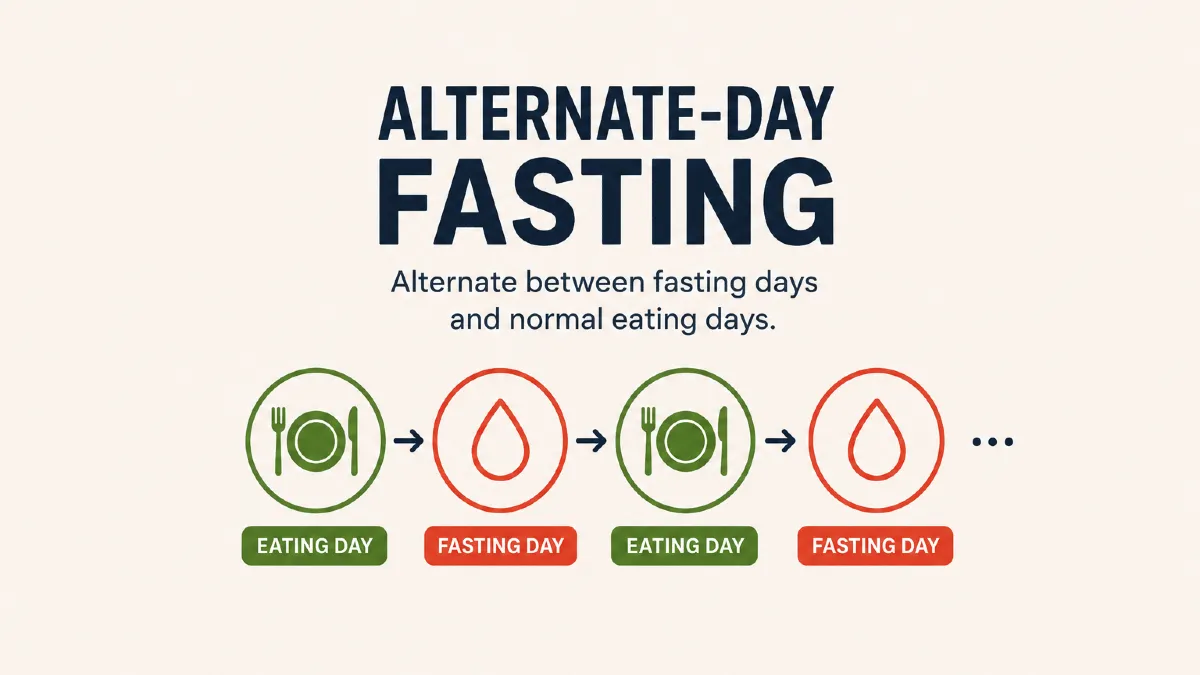
Alternate-day fasting is an approach to weight loss in which days of fasting or significant calorie restriction are alternated with days of normal eating.
Rather than trying to reduce your calorie intake seven days a week, you create periods of greater restriction and place normal eating days between them.
There are several ways to do this.
At one end is strict alternate-day fasting, where you eat normally one day and consume no calories the next. A less extreme version allows a limited number of calories on fasting days. More flexible weekly approaches include the 5:2 diet, with two low-calorie days per week, and the 4:3 diet, with three low-calorie days and four normal eating days.
They differ in how often you restrict calories and how rigidly the days alternate, but they share a useful principle: calorie restriction doesn’t necessarily have to happen every day.
Understanding the differences can help you choose an approach that fits your life rather than trying to fit your life around a diet.
How Does Alternate-Day Fasting Work?
In its strictest form, alternate-day fasting follows a simple repeating cycle:
Day 1: Normal eating
Day 2: Fasting
Day 3: Normal eating
Day 4: Fasting
The pattern then continues regardless of the day of the week.
This is the traditional definition of alternate-day fasting, often abbreviated as ADF.
However, fasting doesn’t always mean consuming absolutely no food. Modified approaches use very low-calorie days instead, and other forms of intermittent energy restriction organize those restricted days within a weekly schedule.
That distinction has led to several different methods.
Strict Alternate-Day Fasting
Traditional ADF is the most restrictive version.
On eating days, you eat normally. On fasting days, you consume no calories, although water and other calorie-free drinks are generally permitted.
The main attraction is simplicity. There are no low-calorie meals to calculate or complicated weekly schedules to remember. You simply alternate between eating days and fasting days.
But simplicity doesn’t necessarily mean convenience.
Because the cycle operates continuously, fasting days move through the week. A Friday that is an eating day this week could be a fasting day the following week.
That can become inconvenient when fasting collides with restaurant visits, family dinners, holidays, work events or other social occasions.
And for many people, going an entire day without eating is a much bigger commitment than simply eating less.
This led to a more flexible version of the concept.
Modified Alternate-Day Fasting
Modified alternate-day fasting keeps the alternating pattern but allows food on restricted days.
A common approach is to consume approximately 20–25% of your usual energy needs on those days.
If your body normally requires around 2,000 calories per day, for example, a restricted day might contain approximately 400–500 calories.
The following day you return to normal eating.
Allowing food can make the restricted days easier to manage. Instead of deciding whether you can tolerate an entire day without eating, the challenge becomes deciding how to use a limited calorie allowance effectively.
You might choose one substantial meal, several small meals or foods that provide plenty of volume for relatively few calories.
However, modified ADF retains one characteristic of the traditional method: roughly every second day is restricted.
For people who like the idea of alternating restriction with normal eating but want greater control over their schedule, weekly approaches offer another possibility.
The 5:2 Diet
The 5:2 diet organizes intermittent calorie restriction around the seven-day week.
Instead of following an endless every-other-day cycle, you choose two days each week for substantial calorie restriction and eat normally during the remaining five.
A week could look like this:
Monday: Low-calorie day
Tuesday: Normal eating
Wednesday: Normal eating
Thursday: Low-calorie day
Friday: Normal eating
Saturday: Normal eating
Sunday: Normal eating
The restricted days can be separated, which means you can choose days that work well with your schedule.
This flexibility is one of the biggest differences from traditional ADF.
If you regularly go out for dinner on Fridays, Friday doesn’t have to become a fasting day simply because that’s where an alternating sequence happens to land.
The 5:2 method also leaves five normal eating days each week, which makes it an appealing introduction to intermittent calorie restriction.
For someone primarily interested in weight loss, however, there is a tradeoff: only two days of the week are used for substantial calorie restriction.
A person who likes the flexibility of 5:2 but wants to create a larger weekly calorie deficit may therefore consider adding a third low-calorie day.
That brings us to the 4:3 diet.
The 4:3 Diet
The 4:3 diet divides the week into:
3 low-calorie days
and
4 normal eating days.
For example:
Monday: Low calorie
Tuesday: Normal eating
Wednesday: Low calorie
Thursday: Normal eating
Friday: Low calorie
Saturday: Normal eating
Sunday: Normal eating
This gives you one more restricted day than 5:2 while still leaving the majority of the week for normal eating.
That makes 4:3 an interesting middle ground.
You aren’t restricting calories every day.
You don’t have to consume zero calories.
And you aren’t tied to a continuous every-other-day cycle.
Instead, you decide where your three low-calorie days fit into your week.
That flexibility can be particularly valuable because diets aren’t followed in laboratories. They’re followed while working, traveling, seeing friends, raising families and going to restaurants.
A method that works mathematically but constantly clashes with your life can be difficult to maintain.
Why Can Alternating Calories Lead to Weight Loss?
Regardless of which version you choose, overall energy intake remains important.
If your body consistently uses more energy than you consume, the resulting calorie deficit can lead to weight loss over time.
A conventional diet often tries to create that deficit by reducing calories every day.
For example, someone who would normally consume 2,000 calories per day might aim for 1,500 calories every day while dieting.
But a calorie deficit doesn’t have to be distributed equally across all seven days.
Intermittent approaches concentrate more of the reduction into selected days.
This changes the structure of the diet without changing the basic requirement that overall energy intake must be low enough to create a deficit.
There is an important catch.
Normal eating days aren’t compensation days.
If someone severely restricts calories on Monday and then deliberately overeats on Tuesday because they “earned it,” some or all of Monday’s deficit can disappear.
The goal is therefore not to alternate between deprivation and feasting.
It’s to alternate between low-calorie days and normal eating days.
That difference matters.
Why Some People Prefer This to Dieting Every Day
Daily calorie restriction can work extremely well, but it asks for consistency every day.
There is no built-in finish line after a difficult day because tomorrow is another calorie-restricted day.
An alternating approach changes that experience.
A low-calorie day has a clear endpoint.
If today is difficult, tomorrow isn’t another identical dieting day. It’s a normal eating day.
For some people, short periods of greater restriction are easier to manage than moderate restriction that never seems to end.
Other people will feel exactly the opposite and prefer eating roughly the same amount every day.
Neither preference is wrong.
The practical question isn’t simply which method looks best on paper. It’s which structure you can realistically maintain long enough to achieve your goal.
Strict Alternate-Day Fasting, 5:2 or 4:3?
The main differences become clearer when you compare the schedules.
With strict alternate-day fasting, approximately every second day is a complete fast. It offers a very simple structure but little control over which days become fasting days.
With modified alternate-day fasting, you keep approximately the same alternating schedule but eat a limited amount on restricted days instead of completely fasting.
With 5:2, you reduce the number of restricted days to two each week and gain much more freedom over when they occur.
With 4:3, you use three low-calorie days each week while retaining four normal eating days and control over your schedule.
So the decision largely comes down to a balance between restriction and flexibility.
If complete fasting doesn’t bother you and you enjoy a rigid pattern, traditional ADF may appeal to you.
If maximizing the number of normal eating days is your priority, 5:2 may be preferable.
But there is a gap between those two approaches.
And that’s where I think 4:3 becomes particularly interesting.
Why Choose 4:3 Instead of 5:2?
The attraction of 5:2 is obvious: you only have two low-calorie days to manage.
But the same feature that makes it easier also means there are only two days each week producing the larger calorie reduction.
Adding a third low-calorie day changes that equation.
Imagine, purely as an example, that someone normally eats 2,000 calories per day and chooses to eat 750 calories on each low-calorie day.
Each of those days reduces intake by approximately 1,250 calories compared with their normal intake.
Two such days would create a theoretical reduction of:
2,500 calories per week.
Three would create:
3,750 calories per week.
Real-world weight loss is more complicated than a simple calculation, and individual energy requirements vary. But the example illustrates why the third day can matter.
Instead of trying to make the two 5:2 days increasingly restrictive, you can spread the calorie reduction across three days.
And unlike strict ADF, you still aren’t committing roughly half of all your days to fasting.
For someone who finds 5:2 attractive but wants a stronger weight-loss structure, 4:3 can be a logical next step.
Why Choose 4:3 Instead of Strict Alternate-Day Fasting?
Here, the advantage is different.
Traditional alternate-day fasting can involve more fasting and a more rigid schedule than some people want.
With 4:3, the week is predictable.
You know that you have three low-calorie days and four normal days, and you can arrange them around your commitments.
Suppose you have dinner plans on Friday and a family event on Sunday.
Those can simply be normal eating days.
Your low-calorie days could be Monday, Wednesday and Saturday—or another combination that works for you.
You’re adapting the diet to your schedule rather than allowing an alternating calendar to determine when you can eat normally.
The restricted days also don’t have to mean going without food.
This combination of three substantial calorie-restriction days, four normal days and a flexible weekly schedule is what makes the approach different.
Does It Matter Which Three Days You Choose?
The practical answer is that the best days are usually the ones you’re most likely to follow consistently.
Look at your normal week.
Maybe Mondays are easy because you’re busy with work and rarely go out.
Perhaps Wednesdays work for the same reason.
Friday night, on the other hand, might regularly involve dinner with friends.
Instead of repeatedly fighting your lifestyle, you can choose low-calorie days that naturally create less friction.
You may also prefer separating them so that a normal eating day follows each restricted day.
The point isn’t to find a universally perfect Monday-Wednesday-Friday formula.
It’s to build a repeatable weekly routine.
Once the days become familiar, you don’t need to renegotiate your diet with yourself every morning.
You already know what kind of day it is.
The Best Diet Isn’t Necessarily the Most Restrictive
It’s tempting to assume that if some calorie restriction works, more restriction must always be better.
But a diet only helps while you’re actually following it.
An extremely aggressive plan that lasts ten days isn’t automatically superior to a more moderate approach you can live with for months.
That’s why the differences between alternate-day methods matter.
They give you different ways to balance calorie restriction against normal life.
The 5:2 diet places more weight on flexibility.
Strict ADF places more weight on frequent fasting.
The 4:3 diet sits between them, with three low-calorie days providing meaningful opportunities to reduce weekly calorie intake while four normal days keep restriction from becoming an everyday requirement.
For me, that balance is the key attraction.
A Different Way to Think About Weight Loss
Many diets begin with the assumption that losing weight means eating less every day.
Monday: diet.
Tuesday: diet.
Wednesday: diet.
And so on until you reach your goal.
Alternate-day approaches challenge that assumption.
Instead of asking yourself to maintain exactly the same restriction every day, you can organize your calorie intake across the week.
Some days are deliberately low.
The others are normal.
That was the idea that ultimately appealed to me.
I wanted an approach that could create a meaningful calorie deficit without making every day feel like a dieting day.
The 4:3 structure gave me that balance, and it became the approach I used to lose 50 pounds and maintain that weight loss.
Want to Try the 4:3 Diet?
The basic concept is easy to understand:
Three low-calorie days. Four normal eating days.
Putting it into practice is where the details begin to matter.
How many calories should you eat on low-calorie days?
Which three days should you choose?
What foods make those days easier?
How should you approach the four normal days?
What happens when your schedule changes?
How do you handle restaurants, weekends and holidays without abandoning the plan?
Those are the practical questions I wanted to answer when I created The 4:3 Diet.
The guide explains the approach I used to lose 50 pounds and, more importantly, turn it into something I could continue living with.
If restricting calories every single day has never felt sustainable to you, you may not need another seven-day diet.
You may simply need a different way to structure your week.
Sources
https://pmc.ncbi.nlm.nih.gov/articles/PMC11504329/
https://pmc.ncbi.nlm.nih.gov/articles/PMC10528701/
https://pmc.ncbi.nlm.nih.gov/articles/PMC10485895/
https://pmc.ncbi.nlm.nih.gov/articles/PMC8744103/